 |
µOS++ IIIe Reference 7.0.0
The third edition of µOS++, a POSIX inspired open source framework, written in C++
|
|
µOS++ IIIe Reference 7.0.0
The third edition of µOS++, a POSIX inspired open source framework, written in C++
|
Timer attributes. More...
#include <cmsis-plus/rtos/os.h>
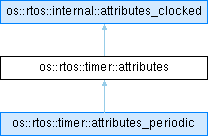
 Inheritance diagram for os::rtos::timer::attributes:
Public Member Functions | |
Constructors & Destructor | |
| constexpr | attributes () |
| Construct a timer attributes object instance. | |
| attributes (const attributes &)=default | |
| attributes (attributes &&)=default | |
| attributes & | operator= (const attributes &)=default |
| attributes & | operator= (attributes &&)=default |
| ~attributes ()=default | |
| Destruct the timer attributes object instance. | |
Public Attributes | |
Public Member Variables | |
| type_t | tm_type = run::once |
| Timer type attribute. | |
Public Member Variables | |
| rtos::clock * | clock = nullptr |
| Attribute with the address of the clock to be used for timeouts. | |
Allow to assign a name to the timer.
To simplify access, the member variables are public and do not require accessors or mutators.
If the attributes are modified after the timer creation, the timer attributes shall not be affected.
Definition at line 130 of file os-timer.h.
|
constexpr |
|
default |
|
default |
|
default |
|
default |
|
default |
|
inherited |
It may be one of os::rtos::sysclock, os::rtos::rtclock, or any other user object derived from class os::rtos::clock.
If nullptr, the default clock is os::rtos::sysclock.
Definition at line 612 of file os-decls.h.
Referenced by os::rtos::event_flags::event_flags(), os::rtos::mutex::mutex(), and os::rtos::timer::timer().
Definition at line 187 of file os-timer.h.
Referenced by os::rtos::timer::timer(), and osTimerCreate().
 1.9.7
1.9.7