|
micro-test-plus 6.0.0
µTest++ Testing Framework
|
|
micro-test-plus 6.0.0
µTest++ Testing Framework
|
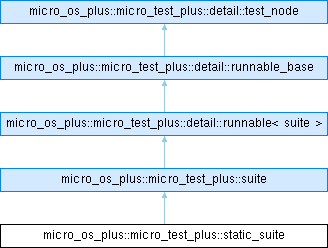
A test suite designed for static (namespace-scope) registration with a runner. More...
#include "micro-os-plus/micro-test-plus.h"
Public Member Functions | |
| static_suite (const static_suite &)=delete | |
| Deleted copy constructor to prevent copying. | |
| template<typename Callable_T, typename... Args_T> requires (!detail::static_suite_body<Callable_T, Args_T...> && detail::suite_body<Callable_T, Args_T...>) | |
| static_suite (located_name name, runner &test_runner, Callable_T &&callable, Args_T &&... arguments) | |
| Constructs a static suite, and links it into the list of suites. | |
| static_suite (static_suite &&)=delete | |
| Deleted move constructor to prevent moving. | |
| ~static_suite () override | |
| Virtual destructor. | |
| const char * | name (void) const noexcept |
| Returns the node name. | |
| static_suite & | operator= (const static_suite &)=delete |
| Deleted copy assignment operator to prevent copying. | |
| static_suite & | operator= (static_suite &&)=delete |
| Deleted move assignment operator to prevent moving. | |
| template<typename Callable_T, typename... Args_T> requires detail::test_body<Callable_T, Args_T...> | |
| void | test (const located_name &name, Callable_T &&callable, Args_T &&... arguments) |
| Adds a test case to the suite, and runs it. | |
| template<typename T, typename Callable_T> | |
| void | test_each (const located_name &name, std::initializer_list< T > values, Callable_T &&callable) |
| Adds a test case to the suite for each value of a braced list, and runs them. | |
| template<typename Values_T, typename Callable_T> requires (detail::test_values_range<Values_T> or detail::test_values_tuple<Values_T>) | |
| void | test_each (const located_name &name, Values_T &&values, Callable_T &&callable) |
| Adds a test case to the suite for each value of a range or a tuple, and runs them. | |
| const counters & | totals (void) const noexcept |
| Returns the totals of the node. | |
Deprecated Functions | |
| template<typename Callable_T, typename... Args_T> requires (detail::static_suite_body<Callable_T, Args_T...>) | |
| static_suite (located_name name, runner &test_runner, Callable_T &&callable, Args_T &&... arguments) | |
| Deprecated constructor, for a body whose first parameter is static_suite&. | |
Deprecated Functions of suite | |
| const detail::stopwatch & | timings (void) const noexcept |
| Deprecated access to the timings of the suite. | |
| detail::stopwatch & | timings (void) noexcept |
| Deprecated access to the timings of the suite, as a non-const reference. | |
Deprecated Functions of runnable_base | |
| size_t | own_index (void) const noexcept |
| Deprecated positional index of this node within its parent. | |
| size_t | current_subtest_index (void) const noexcept |
| Deprecated number of the most recent child test point. | |
| size_t | children_subtests_count (void) const noexcept |
| Deprecated number of direct child test cases of this node. | |
Protected Member Functions | |
| bool | accepts_test_case (const suite &target, const located_name &name) |
| Checks whether a test case can be created on a suite. | |
| void | after_test_case_create (class test_case &test_case, suite &suite) |
| Counts a newly constructed child test case and executes it immediately. | |
| template<typename Callable_T, typename... Args_T> | |
| void | create_test_case (const located_name &name, suite &parent_suite, size_t nesting_depth, Callable_T &&callable, Args_T &&... arguments) |
| Creates a child test case, and runs it. | |
| suite * | exchange_running_suite (suite *running) noexcept |
| Replaces the suite whose body is running in the owning runner, and returns the previous one. | |
| bool | has_running_test_case_of (const suite &target) const noexcept |
| Checks whether the innermost running test case belongs to a suite. | |
| bool | is_aborted (void) const noexcept |
| Checks whether the test execution was aborted by the owning runner. | |
| bool | is_listing (void) const noexcept |
| Checks whether the owning runner lists the test cases instead of running them. | |
| size_t | next_test_point_number (void) noexcept |
| Advances to the next child test point, and returns its number. | |
| void | reject_body_exception (void) |
| Reports the exception that escaped the body of a suite while the test cases are listed, and records it. | |
| class test_case * | running_test_case (void) const noexcept |
| Returns the innermost test case being run by the owning runner, if any. | |
| class reporter & | test_reporter (void) const noexcept |
| Returns the test reporter associated with this test runnable. | |
| runner & | test_runner (void) const noexcept |
| Returns the test runner that owns this test runnable. | |
Protected Attributes | |
| size_t | child_test_cases_count_ = 0 |
| The number of direct child test cases. | |
| const char * | name_ |
| The node name. | |
| size_t | own_index_ |
| The test index, counting from 1. | |
| runner & | runner_ |
| Reference to the test runner that owns this object. | |
| size_t | test_point_number_ = 0 |
| The number of the most recent child test point. | |
| counters | totals_ |
| Totals for the node. | |
Private Member Functions | |
| void | abort (const reflection::source_location &sl=reflection::source_location::current()) const |
| Aborts test execution via the owning runner, for a failed requirement. | |
| void | fail_unexpected_exception (const char *what) |
| Reports an exception that escaped the suite body as a failed check of the suite. | |
| void | link (void) noexcept |
| Inserts this suite into the list of suites. | |
| void | link_or_reject (void) noexcept |
| Inserts this suite into the list of suites, or reject it. | |
| void | run (void) override |
| Executes the suite body by invoking the stored callable. | |
| void | unlink (void) noexcept |
| Removes this suite from the list of suites. | |
Private Attributes | |
| std::function< void(suite &)> | callable_ |
| Callable storing the suite body and any bound arguments. | |
| located_name | located_name_ |
| The name of the suite, with the location where it was given. | |
| suite * | next_ = nullptr |
| The next suite in the list of suites. | |
| detail::stopwatch | stopwatch_ |
| Stopwatch of this suite. | |
Static Private Attributes | |
| static suite * | first_ = nullptr |
| The first suite in the list of suites. | |
static_suite extends suite to support the pattern where test suites are declared as namespace-scope objects and therefore constructed before or after the runner instance, in unspecified static-initialisation order.
Upon construction, the suite inserts itself into the list of suites, kept sorted by name, which does not depend on the runner object (see suite). The runner is only referred to, not accessed, so it may be constructed later. When runner::run_suites() is called, the runner runs the suites that refer to it, static or registered with runner::add_suite(), in the order of the list; for equal names, in the order of their insertion, so the static suites constructed before main() run first. Upon destruction, the suite removes itself from the list.
The list is shared by all the runners, and each runner runs only the suites that refer to it, so several runners may each have their own static suites. A static suite constructed once its runner's run_suites() has started, for example a local one, is rejected, since it would never run; the error is reported on stderr, and the exit code of the runner is not 0. The runner should outlive the static suites that refer to it; a suite left after its runner was destroyed is never run, but does not affect the other runners.
The body is stored in the callable inherited from suite, and is run by suite::run(); the user callable receives a suite& reference, as for the suites registered with runner::add_suite(), so the same function can serve both kinds of suites. A function written for v5.0.1, with a static_suite& first parameter, is still accepted, by a deprecated constructor.
The class is non-copyable and non-movable to preserve unique ownership and consistent state throughout the test session.
| micro_os_plus::micro_test_plus::static_suite::static_suite | ( | located_name | name, |
| runner & | test_runner, | ||
| Callable_T && | callable, | ||
| Args_T &&... | arguments ) |
The runner is only referred to, not accessed, so it may be a namespace-scope object constructed after this suite.
| Callable_T | The type of a callable object. |
| Args_T | The types of the callable arguments. |
| name | The test suite name or description, used in reports; a string literal, a const char*, a std::string, or a std::string_view, converted implicitly to located_name, which copies it, so the string need not outlive the call; the suite keeps it. |
| test_runner | The test runner that runs this suite. |
| callable | A generic callable object, usually a lambda or function, invoked to perform the test suite. Its first parameter must be suite&. |
| arguments | A possibly empty list of arguments forwarded to the callable after the leading suite& reference. |
Delegates to suite, which stores the callable and binds its arguments, if any, and keeps the name, moved; the callable receives a suite& reference, as for the suites registered with runner::add_suite(). After construction, the suite is inserted into the list of suites, to be run by its runner, unless the runner has already started, when the suite is rejected; a runner that has not started is not accessed.
Delegates to suite with a lambda that holds a copy of the callable (decayed, so a function is held as a pointer), and invokes it with the suite& reference converted to static_suite&, followed by the stored arguments, which suite binds as for the other bodies. The conversion is valid, since suite::run() passes this object. The extra call happens once for each run of the suite, not for each test case.
Definition at line 1180 of file test-inlines.h.
References static_suite(), micro_os_plus::micro_test_plus::suite::suite(), micro_os_plus::micro_test_plus::suite::micro_test_plus::runner, micro_os_plus::micro_test_plus::detail::runnable_base::name(), and micro_os_plus::micro_test_plus::detail::runnable_base::test_runner().
Referenced by static_suite(), static_suite(), static_suite(), operator=(), and operator=().
| micro_os_plus::micro_test_plus::static_suite::static_suite | ( | located_name | name, |
| runner & | test_runner, | ||
| Callable_T && | callable, | ||
| Args_T &&... | arguments ) |
In v5.0.1, the body of a static suite received a static_suite& reference; it now receives a suite& one, so that the same function can serve the suites registered with runner::add_suite(). To keep the functions written for v5.0.1 working, the body is wrapped in a function object that converts the suite& reference back to static_suite&, which is always valid, since the suite that runs the body is this object.
The deprecation is reported where the suite is declared; to remove it, change the first parameter of the function to suite&.
| Callable_T | The type of a callable object. |
| Args_T | The types of the callable arguments. |
| name | The test suite name or description, used in reports; a string literal, a const char*, a std::string, or a std::string_view, converted implicitly to located_name, which copies it, so the string need not outlive the call; the suite keeps it. |
| test_runner | The test runner that runs this suite. |
| callable | A function or callable object whose first parameter is static_suite&. |
| arguments | A possibly empty list of arguments forwarded to the callable after the leading static_suite& reference. |
References micro_os_plus::micro_test_plus::suite::micro_test_plus::runner, micro_os_plus::micro_test_plus::detail::runnable_base::name(), and micro_os_plus::micro_test_plus::detail::runnable_base::test_runner().
|
delete |
A copy would duplicate the counters and the stored body.
References static_suite().
|
delete |
Nodes are referred to by address (e.g. by their children and by the runner), so they must not be relocated.
References static_suite().
|
override |
The suite is removed from the list of suites by the suite destructor; the stored callable is destroyed with the suite members.
The suite is removed from the list of suites by the suite destructor. If tracing is enabled, the suite name is output for diagnostic purposes.
Definition at line 825 of file test.cpp.
References micro_os_plus::micro_test_plus::detail::runnable_base::name_.
|
privateinherited |
Private, since it is used only by the check result, a friend, for a failed requirement without exceptions; the user code calls runner::abort().
| sl | The source location from which the abort is triggered. |
Delegates to the private runner::abort(), as caused by a failed requirement, passing the supplied source location, so that the report identifies it. The runner then calls the abort handler, if any, and terminates the process via ::abort().
Definition at line 306 of file test.cpp.
References micro_os_plus::micro_test_plus::runner::abort(), and runner_.
Referenced by micro_os_plus::micro_test_plus::detail::check_result::~check_result(), and run().
|
nodiscardprotectedinherited |
Protected, since it is used only by suite::test(). A test case can be created only on the suite whose body is running (the top suite, between runner::add_top_suite() and runner::run_suites(), or the suite being run). A call on any other suite, for example on the top suite from the body of another suite, on a static suite before the runner was initialised, or after runner::run_suites() returned, would run the test case where its results cannot be reported correctly. Such a call is rejected: the failure is reported as a failed check of the running test case, if one runs, otherwise in the running suite, or, when no suite runs, on stderr, and the rejection is remembered by the runner, which makes the exit code non-zero. When the session was declined (option errors, or --help), or aborted, the test cases are ignored silently, as after_test_case_create() ignores them.
| target | The suite on which the test case is created. |
| name | The name and the location of the test case, for the message. |
| true | The test case can be created. |
| false | The test case must not be created. |
The suite whose body runs accepts the test case. When the session was declined, or aborted, the test case is ignored, as after_test_case_create() ignores it.
Otherwise the call is rejected. If a test case runs (and the test cases are not only listed), the failure is reported as a check of that test case, so that it stays in its report. Otherwise, if a suite runs, the failure is reported as a check of that suite, with the same numbering and counting as the unexpected exceptions of the suite body. Otherwise (the runner was not initialised, has not started the suites, or has finished them, or the test cases are listed) the failure is given to runner::reject_call(), which writes the message on stderr and, where the reporter can still write it, as a comment line, for example in the list, and runner::mark_rejected() makes the exit code non-zero, as for the suites added too late.
Definition at line 239 of file test.cpp.
References micro_os_plus::micro_test_plus::runner::aborted_, micro_os_plus::micro_test_plus::detail::reporter::fail_suite(), micro_os_plus::micro_test_plus::runner::has_option_errors(), micro_os_plus::micro_test_plus::runner_options::help, micro_os_plus::micro_test_plus::counters::increment_failed_checks(), micro_os_plus::micro_test_plus::runner_options::list_tests, micro_os_plus::micro_test_plus::located_name::location(), name(), micro_os_plus::micro_test_plus::located_name::name(), next_test_point_number(), micro_os_plus::micro_test_plus::runner::options_, micro_os_plus::micro_test_plus::runner::reject_call(), micro_os_plus::micro_test_plus::test_case::report_rejected_test(), runner_, micro_os_plus::micro_test_plus::runner::running_suite_, micro_os_plus::micro_test_plus::runner::running_test_case_, test_reporter(), and totals_.
Referenced by run(), and micro_os_plus::micro_test_plus::suite::test().
|
protectedinherited |
The child test case is a local object of create_test_case(), and is destroyed when that function returns.
| test_case | The newly created test_case. |
| suite | The parent suite to which execution results are reported. |
Counts test_case, which is a local object of the calling create_test_case(), and immediately invokes test_case::run() on it. The test case is not kept; only child_test_cases_count_ is needed later, for the TAP plan.
If the filter patterns do not select the test case (its own name at its nesting level, or the name of suite at level 0, which matters only for the top suite, since the other suites run only when selected), its body is not called: the reporter is notified with skip_test_case() and the parent's skipped test cases counter is incremented. The test case keeps its index and its place among the children, so the TAP plan of the parent remains complete.
Otherwise, while the test case runs, the runner keeps it as its innermost running test case (see suite::test()). The parent's executed test cases counter is incremented after the run, and, if the child failed (a failed check, or a failed nested test case), its failed test cases counter too, so that the parent fails as well, as in node-tap. The child's check counters are intentionally not merged into the parent totals; each test case reports only its own counters. The child's totals are, however, accumulated into suite so that the suite summary reflects all checks performed by its test cases.
While the test cases are listed (see runner_options::list_tests), the selected test case is listed by the runner, and neither run nor counted, except in child_test_cases_count_.
After the test execution was aborted (possible only when the abort handler threw an exception, which the application caught), the report is complete, so the test case is neither run nor reported. The same applies when the runner refused to run the tests because of errors in the options, or because the output file could not be opened (see runner::has_option_errors()), or because the options requested the usage (--help).
Definition at line 350 of file test.cpp.
References micro_os_plus::micro_test_plus::runner::aborted_, child_test_cases_count_, micro_os_plus::micro_test_plus::runner::has_option_errors(), micro_os_plus::micro_test_plus::runner_options::help, micro_os_plus::micro_test_plus::counters::increment_executed_test_cases(), micro_os_plus::micro_test_plus::counters::increment_failed_test_cases(), micro_os_plus::micro_test_plus::counters::increment_skipped_test_cases(), micro_os_plus::micro_test_plus::runner::is_selected(), micro_os_plus::micro_test_plus::runner::list_test_case(), micro_os_plus::micro_test_plus::runner_options::list_tests, name(), micro_os_plus::micro_test_plus::test_case::nesting_depth(), micro_os_plus::micro_test_plus::runner::options_, micro_os_plus::micro_test_plus::counters::passed(), runner_, micro_os_plus::micro_test_plus::runner::running_test_case_, micro_os_plus::micro_test_plus::detail::reporter::skip_test_case(), test_reporter(), totals(), and totals_.
Referenced by create_test_case(), and run().
|
inlinenodiscardnoexceptinherited |
Used only for the TAP plan, by the reporters, which access it directly. The test cases skipped by the filter are included.
Returns the number of direct child test cases, including those skipped by the filter.
Definition at line 241 of file test-inlines.h.
References child_test_cases_count_.
Referenced by operator=().
|
inlineprotectedinherited |
The common body of suite::test() and test_case::test(), which differ only in the parent suite and the nesting depth of the test cases they create.
Always inlined into them, even without optimisations, since each nested test case adds one call chain to the stack, and a separate frame for this function would make it longer.
The test case runs and ends within the call, so, without additional arguments, it refers to the callable of the caller, which is neither copied nor moved, and is called in place, so a callable that cannot be copied is accepted, and an lvalue callable keeps the changes of its state. With additional arguments, the callable and the arguments are bound into a body of copies, by bind_callable().
| Callable_T | The type of a callable object. |
| Args_T | The types of the callable arguments. |
| name | The test case name or description, used in reports, and the location of the call to test(). |
| parent_suite | The suite to which the test case belongs. |
| nesting_depth | The depth of nesting of the test case; 1 for the direct children of a suite. |
| callable | A generic callable object, usually a lambda, invoked to perform the test. |
| arguments | A possibly empty list of arguments to be passed to the callable. |
Without additional arguments, the child test_case is a local object that refers to the callable of the caller, which is neither copied nor moved, and is called in place (an lvalue callable keeps the changes of its state). A function is referred to through its pointer, and the callable and the additional arguments are bound into a local body, as copies, when there are arguments. The child is constructed with the next test point number of this node as its index, then passed to after_test_case_create(), which counts and runs it.
The child test case and its body, with the copies of the arguments, are destroyed when this function returns, so the memory used by a test session does not grow with the number of test cases; the stack holds one test case and one body for each level of nesting being run. Since the body is not stored in a std::function, it is never allocated, whatever the size of the lambda captures and of the arguments.
Definition at line 292 of file test-inlines.h.
References after_test_case_create(), micro_os_plus::micro_test_plus::detail::bind_callable(), name(), next_test_point_number(), own_index(), and runner_.
Referenced by run(), micro_os_plus::micro_test_plus::suite::test(), and micro_os_plus::micro_test_plus::test_case::test().
|
inlinenodiscardnoexceptinherited |
Used only for the TAP output, by the reporters, which access it directly.
Returns the number of the most recent child test point.
Definition at line 229 of file test-inlines.h.
References test_point_number_.
Referenced by operator=().
|
protectednoexceptinherited |
Protected, since it is used only by suite::run(), to mark the suite whose body is being called, and to restore the previous value when the body returns.
| running | The suite that starts to run, or the previous one, to restore it. |
Sets the pointer of the runner, a friend, and returns the previous value, so that the caller can restore it when the body returns.
Definition at line 212 of file test.cpp.
References runner_.
Referenced by run(), and micro_os_plus::micro_test_plus::suite::run().
|
privateinherited |
The suite body may throw outside its test cases, for example in a set-up step; the test cases catch their own exceptions. The failure is reported without a source location, since the suites do not record one, and the location of the throw is not known.
| what | The explanatory string of a std::exception, or nullptr for an exception of another type. |
The failure is reported as a check of the suite: the test point number is incremented first, so that the TAP output numbers it after the test cases already run, and counts it in the plan of the suite, and the failed checks counter is incremented, so that the suite, and through it the session, fail.
The message is unexpected exception in the suite body: followed by what, or unexpected exception of unknown type in the suite
body when what is nullptr; as for the test cases, the type of a std::exception is not shown.
Definition at line 701 of file test.cpp.
References micro_os_plus::micro_test_plus::detail::reporter::fail_suite(), micro_os_plus::micro_test_plus::counters::increment_failed_checks(), micro_os_plus::micro_test_plus::detail::runnable_base::next_test_point_number(), micro_os_plus::micro_test_plus::detail::runnable_base::test_reporter(), and micro_os_plus::micro_test_plus::detail::runnable_base::totals_.
Referenced by operator=(), and run().
|
nodiscardprotectednoexceptinherited |
Protected, since it is used only by suite::test(), to forward a test case started on the suite to the running test case only when that is a test case of the same suite; the test cases started on another suite are rejected.
| target | The suite to check. |
| true | A test case is running, and its parent suite is target. |
| false | No test case is running, or it belongs to another suite. |
Reads the pointer of the runner, a friend, and the parent suite of the test case, which runnable_base may access.
Definition at line 199 of file test.cpp.
References micro_os_plus::micro_test_plus::test_case::parent_suite_, and runner_.
Referenced by run(), and micro_os_plus::micro_test_plus::suite::test().
|
nodiscardprotectednoexceptinherited |
Protected, since it is used only by test_case::run() and suite::run(), to pass on an exception thrown by the abort handler, instead of reporting it as unexpected.
Returns the flag kept by the owning runner, set by runner::abort() and never cleared.
Definition at line 177 of file test.cpp.
References runner_.
Referenced by run(), micro_os_plus::micro_test_plus::suite::run(), and micro_os_plus::micro_test_plus::test_case::run().
|
nodiscardprotectednoexceptinherited |
Protected, since it is used only by suite::run(), which then calls the suite body without reporting the suite, so that its test cases are created, and listed instead of run.
Returns runner_options::list_tests of the session options kept by the owning runner.
Definition at line 188 of file test.cpp.
References runner_.
Referenced by run(), and micro_os_plus::micro_test_plus::suite::run().
|
privatenoexceptinherited |
Called by runner::register_suite() and by the static_suite constructor, after the name was copied. The suite is inserted after the suites with names less than or equal to its own, so the list remains sorted by name, and the suites with the same name remain in the order of their insertion. The top suite is not inserted, since the runner runs it separately.
Inserts the suite after the suites with names less than or equal to its own, so the list remains sorted by name, and the suites with the same name remain in the order of their insertion. No memory is allocated. This is the only place where the names of the suites are compared; the runners run the suites in the order of the list.
Definition at line 738 of file test.cpp.
References suite(), first_, micro_os_plus::micro_test_plus::detail::runnable_base::name_, and next_.
Referenced by operator=().
|
privatenoexcept |
Called by the constructors, after the base was constructed. The suite is rejected if its runner has already started, since it would never run; see runner::link_static_suite(). Defined in src/test.cpp, where the runner is a complete type.
Delegates to the runner, which knows whether its session has started.
Definition at line 814 of file test.cpp.
References micro_os_plus::micro_test_plus::runner::link_static_suite(), and micro_os_plus::micro_test_plus::detail::runnable_base::test_runner().
Referenced by operator=().
|
inlinenodiscardnoexceptinherited |
Returns a pointer to the null-terminated name stored in name_.
Definition at line 195 of file test-inlines.h.
References name_.
Referenced by runnable_base(), micro_os_plus::micro_test_plus::runner::runner(), micro_os_plus::micro_test_plus::runner::runner(), micro_os_plus::micro_test_plus::static_suite::static_suite(), micro_os_plus::micro_test_plus::suite::suite(), micro_os_plus::micro_test_plus::test_case::test_case(), micro_os_plus::micro_test_plus::top_suite::top_suite(), accepts_test_case(), micro_os_plus::micro_test_plus::runner::add_top_suite(), after_test_case_create(), micro_os_plus::micro_test_plus::detail::reporter_human::begin_suite(), micro_os_plus::micro_test_plus::detail::reporter_tap::begin_suite(), micro_os_plus::micro_test_plus::detail::reporter_human::begin_test_case(), micro_os_plus::micro_test_plus::detail::reporter_tap::begin_test_case(), create_test_case(), micro_os_plus::micro_test_plus::test_case::detail::runnable_base, micro_os_plus::micro_test_plus::detail::reporter_human::display_open_heading(), micro_os_plus::micro_test_plus::detail::reporter_tap::display_open_heading(), micro_os_plus::micro_test_plus::detail::reporter_human::display_open_names(), micro_os_plus::micro_test_plus::detail::reporter_human::end_suite(), micro_os_plus::micro_test_plus::detail::reporter_tap::end_suite(), micro_os_plus::micro_test_plus::detail::reporter_human::end_test_case(), micro_os_plus::micro_test_plus::detail::reporter_tap::end_test_case(), micro_os_plus::micro_test_plus::detail::reporter_human::fail_suite(), micro_os_plus::micro_test_plus::detail::reporter_tap::fail_suite(), micro_os_plus::micro_test_plus::runner::list_test_case(), micro_os_plus::micro_test_plus::top_suite::micro_test_plus::runner, operator=(), micro_os_plus::micro_test_plus::suite::operator=(), micro_os_plus::micro_test_plus::test_case::operator=(), micro_os_plus::micro_test_plus::test_case::report_misdirected(), micro_os_plus::micro_test_plus::test_case::report_misdirected_test(), reporter_tap, run(), micro_os_plus::micro_test_plus::detail::reporter_human::skip_suite(), micro_os_plus::micro_test_plus::detail::reporter_tap::skip_suite(), micro_os_plus::micro_test_plus::detail::reporter_human::skip_test_case(), micro_os_plus::micro_test_plus::detail::reporter_tap::skip_test_case(), micro_os_plus::micro_test_plus::suite::static_suite, micro_os_plus::micro_test_plus::suite::test(), micro_os_plus::micro_test_plus::test_case::test(), micro_os_plus::micro_test_plus::suite::test_each(), micro_os_plus::micro_test_plus::suite::test_each(), micro_os_plus::micro_test_plus::test_case::test_each(), micro_os_plus::micro_test_plus::test_case::test_each(), and micro_os_plus::micro_test_plus::detail::reporter_tap::write_quiet_failures().
|
inlineprotectednoexceptinherited |
Called for each check (by the check result, when the check is reported) and for each nested test case created.
Each call to test() invokes this member function before constructing the new test_case, and each check invokes it from the check result destructor, when the check is reported, so the numbers form a strictly increasing, one-based sequence of TAP test points, in output order.
Definition at line 255 of file test-inlines.h.
References test_point_number_.
Referenced by micro_os_plus::micro_test_plus::detail::check_result::~check_result(), accepts_test_case(), create_test_case(), micro_os_plus::micro_test_plus::suite::fail_unexpected_exception(), micro_os_plus::micro_test_plus::test_case::fail_unexpected_exception(), micro_os_plus::micro_test_plus::runner::reject_call(), and run().
|
delete |
A copy would duplicate the counters and the stored body.
References static_suite().
|
delete |
Nodes are referred to by address (e.g. by their children and by the runner), so they must not be relocated.
References static_suite(), and link_or_reject().
|
inlinenodiscardnoexceptinherited |
Used only for the TAP output, by the reporters, which access it directly. The setter of v5.0.1, and increment_subtest_index(), were removed, since they allowed the application code to corrupt the numbering of the reports.
Returns the one-based positional index of this node within its parent.
Definition at line 218 of file test-inlines.h.
References own_index_.
Referenced by runnable_base(), micro_os_plus::micro_test_plus::test_case::test_case(), create_test_case(), micro_os_plus::micro_test_plus::test_case::detail::runnable_base, operator=(), and reporter_tap.
|
protectedinherited |
Protected, since it is used only by suite::run(), when there is no test point to fail. It gives the message, which names the suite, to runner::reject_call(), which writes it on stderr and in the listing, and makes the exit code non-zero.
Builds the message here, and not in suite::run(), to keep the frame of that function, which is on the stack of every session, unchanged. Delegates to the private runner::reject_call(), which writes the message on stderr and in the listing, and marks the runner, so that the exit code of runner::run_suites() is not 0.
Definition at line 289 of file test.cpp.
References name_, micro_os_plus::micro_test_plus::runner::reject_call(), and runner_.
Referenced by run(), and micro_os_plus::micro_test_plus::suite::run().
|
overrideprivatevirtualinherited |
Private, since the suites are run only once, by the runner, which is a friend.
Invokes the stored callable with this suite, surrounded by reporter calls to begin and end the suite. While the body runs, this suite is marked, in the runner, as the one that accepts new test cases (see accepts_test_case()); the previous one is restored when the body returns, also when it throws.
While the test cases are listed (see runner_options::list_tests), the body is called only to create its test cases, which are listed; the suite is neither reported nor timed, and an exception that escapes the body is reported by reject_body_exception(), on stderr and in the listing, the exit code is not 0, and the listing continues with the next suite.
When exceptions are enabled, an exception that escapes the callable, which can be thrown only outside the test cases, since they catch their own exceptions, is caught and reported as a failed check of this suite, and the suite ends normally, so that the run continues with the next suite; the test cases run before the exception remain reported, and the following ones are not run. A body declared noexcept cannot pass the exception on; the program is then terminated before it reaches this function.
As for the test cases, an exception thrown by the abort handler is passed on, without reporting it, and without ending the suite.
Implements micro_os_plus::micro_test_plus::detail::runnable_base.
Definition at line 604 of file test.cpp.
References suite(), micro_os_plus::micro_test_plus::detail::reporter::begin_suite(), callable_, micro_os_plus::micro_test_plus::detail::reporter::end_suite(), micro_os_plus::micro_test_plus::detail::runnable_base::exchange_running_suite(), fail_unexpected_exception(), micro_os_plus::micro_test_plus::detail::runnable_base::is_aborted(), micro_os_plus::micro_test_plus::detail::runnable_base::is_listing(), micro_os_plus::micro_test_plus::detail::runnable_base::name_, micro_os_plus::micro_test_plus::detail::runnable_base::reject_body_exception(), micro_os_plus::micro_test_plus::detail::stopwatch::start(), micro_os_plus::micro_test_plus::detail::stopwatch::stop(), stopwatch_, and micro_os_plus::micro_test_plus::detail::runnable_base::test_reporter().
Referenced by operator=().
|
nodiscardprotectednoexceptinherited |
Protected, since it is used only by suite::test(), to run a test case started on the suite from inside a running test case as a nested test case of it.
Returns the pointer kept by the owning runner, set by after_test_case_create() while a test case runs.
Definition at line 166 of file test.cpp.
References runner_.
Referenced by micro_os_plus::micro_test_plus::test_case::is_misdirected(), micro_os_plus::micro_test_plus::test_case::report_misdirected(), micro_os_plus::micro_test_plus::test_case::report_misdirected_test(), run(), and micro_os_plus::micro_test_plus::suite::test().
|
inherited |
| Callable_T | The type of a callable object. |
| Args_T | The types of the callable arguments. |
| name | The test case name or description, used in reports; a string literal, a const char*, a std::string, or a std::string_view, converted implicitly to located_name, which copies it and also captures the location of the call. |
| callable | A generic callable object, usually a lambda, invoked to perform the test. |
| arguments | A possibly empty list of arguments to be passed to the callable. |
The test function template creates a test case (a test_case with nesting depth 1) and runs it immediately. It accepts a descriptive name, a callable object (such as a lambda or function pointer), and an optional list of arguments to be passed to the callable, after the leading test_case& reference. The test case is reported using the provided name.
The test case is created and run by create_test_case(), as a local object destroyed when it returns, together with its stored body and bound arguments; only the number of test cases is kept, for the TAP plan.
Each test case typically involves evaluating logical expressions, such as comparing a computed result to an expected value, with expect() or require(). When exceptions are enabled, it is also possible to verify whether evaluating an expression throws exceptions. Each check either passes or fails, and the suite totals count the passed and failed checks.
It is typically invoked within the body of a suite. When invoked from the body of a running test case of this suite (for example via a captured suite reference), the new test case could not be reported as a sibling of the running one, which has not ended; it is therefore created by the innermost running test case, with test_case::test(), and runs nested in it, as if test() had been called on that test case.
The test case can be created only on the suite whose body is running. A call on another suite (for example on the top suite, captured by reference, from the body of a suite added with runner::add_suite(), or on any suite after runner::run_suites() returned) is rejected: the test case is not run, a failure is reported in the running suite, or, when none runs, an error is written to stderr, and the later calls of runner::run_suites() return a non-zero exit code.
Definition at line 968 of file test-inlines.h.
References micro_os_plus::micro_test_plus::detail::runnable_base::accepts_test_case(), micro_os_plus::micro_test_plus::detail::runnable_base::create_test_case(), micro_os_plus::micro_test_plus::detail::runnable_base::has_running_test_case_of(), micro_os_plus::micro_test_plus::detail::runnable_base::name(), micro_os_plus::micro_test_plus::located_name::name(), and micro_os_plus::micro_test_plus::detail::runnable_base::running_test_case().
Referenced by operator=().
|
inherited |
As the overload for the ranges, for a list written in place, like ts.test_each ("Sizes", { 1, 16, 512 }, ...), whose type cannot be deduced otherwise.
| T | The type of the values. |
| Callable_T | The type of a callable object. |
| name | The common name of the test cases. |
| values | The list of values. |
| callable | A generic callable object, usually a lambda, invoked with the test case and each value. |
The list is iterated as a range.
Definition at line 1135 of file test-inlines.h.
References micro_os_plus::micro_test_plus::detail::runnable_base::name(), and micro_os_plus::micro_test_plus::detail::test_each_value().
|
inherited |
For each value, in order, a test case is added and run, as by test(), with the value as the argument of the callable, which is called as callable (test_case, value). The values may be a range (a container, an array, a span, or a view), or a tuple, whose values may have different types, for a generic callable:
Each test case is named after the common name, followed by the value in parentheses, written as in the messages of the checks (Sizes (16)); a value that cannot be written (see extension::printable), such as an application type without an operator<<, is replaced by its position, starting at 1 (Records (#2)). The location of all the test cases is that of the call.
| Values_T | The type of the range or tuple of values. |
| Callable_T | The type of a callable object. |
| name | The common name of the test cases; a string literal, a const char*, a std::string, or a std::string_view, converted implicitly to located_name, which also captures the location of the call. |
| values | The range or tuple of values. |
| callable | A generic callable object, usually a lambda, invoked with the test case and each value. |
Forwards to detail::test_each_value(), which adds the test cases with test(), so they are nested in the running test case, if any.
Definition at line 1122 of file test-inlines.h.
References micro_os_plus::micro_test_plus::detail::runnable_base::name(), test_each(), and micro_os_plus::micro_test_plus::detail::test_each_value().
Referenced by operator=(), and test_each().
|
nodiscardprotectednoexceptinherited |
Protected, since the reporter is internal to the framework; it is used by the suites and the test cases, which derive from this class, and by the check result, which is a friend.
Not named reporter(), which would hide the class detail::reporter in the derived classes.
Returns the reporter owned by the runner, through its reporter_ pointer, which is valid after runner::initialise().
Definition at line 155 of file test.cpp.
References runner_.
Referenced by micro_os_plus::micro_test_plus::detail::check_result::~check_result(), accepts_test_case(), after_test_case_create(), micro_os_plus::micro_test_plus::test_case::expect(), micro_os_plus::micro_test_plus::suite::fail_unexpected_exception(), micro_os_plus::micro_test_plus::test_case::fail_unexpected_exception(), micro_os_plus::micro_test_plus::test_case::report_misdirected(), micro_os_plus::micro_test_plus::test_case::report_rejected_test(), micro_os_plus::micro_test_plus::test_case::require(), run(), micro_os_plus::micro_test_plus::suite::run(), and micro_os_plus::micro_test_plus::test_case::run().
|
inlinenodiscardprotectednoexceptinherited |
Protected, since the runner is internal to the framework; it is used by the suites and the test cases, which derive from this class and pass it to their nested test cases, and by the runner, which is a friend and selects the static suites it runs.
Not named runner(), which would hide the class runner in the derived classes.
Returns a reference to the owning test runner.
Definition at line 265 of file test-inlines.h.
References runner_.
Referenced by runnable_base(), micro_os_plus::micro_test_plus::static_suite::static_suite(), micro_os_plus::micro_test_plus::suite::suite(), micro_os_plus::micro_test_plus::test_case::test_case(), micro_os_plus::micro_test_plus::top_suite::top_suite(), micro_os_plus::micro_test_plus::test_case::detail::runnable_base, micro_os_plus::micro_test_plus::static_suite::link_or_reject(), micro_os_plus::micro_test_plus::top_suite::micro_test_plus::runner, reporter_tap, run(), and micro_os_plus::micro_test_plus::suite::static_suite.
|
inlinenodiscardnoexceptinherited |
Returns the internal stopwatch of the suite, started before its body runs and stopped after it; for the top suite, it is started by runner::add_top_suite() and stopped by runner::run_suites(). In v5.0.1, the returned class was detail::timestamps, now a deprecated alias; only its read-only members are kept. The timings are internal; the elapsed times are shown by the reporters.
Returns a const reference to the stopwatch member.
Definition at line 1148 of file test-inlines.h.
References stopwatch_.
Referenced by operator=().
|
inlinenodiscardnoexceptinherited |
Kept for the v5.0.1 code that binds a non-const reference (detail::timestamps& t = ts.timings ();). The test code must not start or stop the stopwatch through it, since the reporters show its elapsed time.
Returns a reference to the stopwatch member.
Definition at line 1159 of file test-inlines.h.
References stopwatch_.
|
inlinenodiscardnoexceptinherited |
The reference is read-only, for the const and the non-const nodes alike, so that a test case or a suite cannot modify its own counters, which decide the exit code. The counters are updated only by the framework, which accesses the protected member directly.
Returns a const reference to the counters member.
Definition at line 205 of file test-inlines.h.
References totals_.
Referenced by after_test_case_create(), micro_os_plus::micro_test_plus::detail::reporter_human::end_suite(), micro_os_plus::micro_test_plus::detail::reporter_tap::end_suite(), micro_os_plus::micro_test_plus::detail::reporter_human::end_test_case(), micro_os_plus::micro_test_plus::detail::reporter_tap::end_test_case(), micro_os_plus::micro_test_plus::detail::reporter::format_suite_totals(), micro_os_plus::micro_test_plus::detail::reporter::format_test_case_totals(), operator=(), and micro_os_plus::micro_test_plus::runner::run_suites().
|
privatenoexceptinherited |
Called by the destructor; a suite that is not in the list, such as the top suite or a suite rejected by the runner, is left unchanged.
Searches the list for the suite and, if found, bypasses it.
Definition at line 760 of file test.cpp.
References suite(), first_, and next_.
Referenced by ~suite(), and operator=().
|
privateinherited |
|
protectedinherited |
Incremented for each call to test(), which creates a child test_case and runs it immediately. The child test cases are not kept after they run, so that the memory does not grow with the number of test cases; only their number is needed later, for the TAP plan.
Definition at line 883 of file test.h.
Referenced by after_test_case_create(), children_subtests_count(), micro_os_plus::micro_test_plus::detail::reporter_tap::end_suite(), and micro_os_plus::micro_test_plus::detail::reporter_tap::end_test_case().
|
staticconstinitprivateinherited |
The list includes the registered and the static suites of all runners, sorted by name; each runner selects its own. The pointer is constant-initialised (constinit, in src/test.cpp), so it is null before any constructor runs, whatever the order of the static initialisation across translation units.
Constant-initialised, so it is null before any static constructor runs; the static suites constructed before the runner are therefore not lost.
Definition at line 2475 of file test.h.
Referenced by link(), micro_os_plus::micro_test_plus::runner::run_child_suites(), micro_os_plus::micro_test_plus::runner::static_suites_count(), and unlink().
|
privateinherited |
The suites registered with runner::add_suite(), and the static suites, run later, when the argument passed by the caller no longer exists; it is therefore moved here, and the name of the node points into it. The test cases, which run immediately, refer to the argument of test() instead.
Definition at line 2453 of file test.h.
Referenced by suite(), and micro_os_plus::micro_test_plus::runner::add_top_suite().
|
protectedinherited |
Not owned; it points to a string whose lifetime exceeds that of the node. Derived classes may access this member directly, in addition to the public name() getter.
Definition at line 823 of file test.h.
Referenced by runnable_base(), micro_os_plus::micro_test_plus::suite::suite(), micro_os_plus::micro_test_plus::test_case::test_case(), ~runnable_base(), micro_os_plus::micro_test_plus::static_suite::~static_suite(), micro_os_plus::micro_test_plus::suite::~suite(), micro_os_plus::micro_test_plus::test_case::~test_case(), micro_os_plus::micro_test_plus::top_suite::~top_suite(), micro_os_plus::micro_test_plus::runner::add_top_suite(), micro_os_plus::micro_test_plus::suite::link(), name(), reject_body_exception(), micro_os_plus::micro_test_plus::suite::run(), and micro_os_plus::micro_test_plus::test_case::run().
|
privateinherited |
Null for the last suite, and for the suites not in the list. Set by link() and unlink(), and read by the runner, which is a friend.
Definition at line 2463 of file test.h.
Referenced by link(), micro_os_plus::micro_test_plus::runner::run_child_suites(), micro_os_plus::micro_test_plus::runner::static_suites_count(), and unlink().
|
protectedinherited |
The position of this object within its parent, displayed by the TAP reporter in the ok/not ok lines. Set directly by the runner, which numbers the suites when it runs them, and by the top suite, which, when added, is always the first one.
Definition at line 859 of file test.h.
Referenced by runnable_base(), micro_os_plus::micro_test_plus::suite::suite(), micro_os_plus::micro_test_plus::test_case::test_case(), micro_os_plus::micro_test_plus::top_suite::top_suite(), micro_os_plus::micro_test_plus::detail::reporter_tap::end_suite(), micro_os_plus::micro_test_plus::detail::reporter_tap::end_test_case(), own_index(), micro_os_plus::micro_test_plus::detail::reporter_tap::skip_suite(), and micro_os_plus::micro_test_plus::detail::reporter_tap::skip_test_case().
|
protectedinherited |
Provides access to the reporter, to the filter, and to the state of the session (the running test case, and the abort and listing flags), and is used when aborting.
Definition at line 848 of file test.h.
Referenced by runnable_base(), abort(), accepts_test_case(), after_test_case_create(), create_test_case(), exchange_running_suite(), has_running_test_case_of(), is_aborted(), is_listing(), reject_body_exception(), running_test_case(), test_reporter(), and test_runner().
|
privateinherited |
Measures the duration of the suite; started and stopped by run() (by the runner, for the top suite), and read by the reporters, which are friends.
Definition at line 2441 of file test.h.
Referenced by micro_os_plus::micro_test_plus::runner::add_top_suite(), micro_os_plus::micro_test_plus::detail::reporter_human::end_suite(), micro_os_plus::micro_test_plus::detail::reporter_tap::end_suite(), run(), micro_os_plus::micro_test_plus::runner::run_suites(), timings(), and timings().
|
protectedinherited |
Test points are numbered from 1; the value is 0 before the first one. This number counts the checks and the nested test cases of this object, in execution order, as required by the TAP ok/not ok lines. It is incremented for each check (by the check result) and for each nested test case created.
Definition at line 871 of file test.h.
Referenced by current_subtest_index(), micro_os_plus::micro_test_plus::detail::reporter_tap::end_suite(), micro_os_plus::micro_test_plus::detail::reporter_tap::fail_suite(), next_test_point_number(), micro_os_plus::micro_test_plus::detail::reporter_tap::output_fail_prefix(), micro_os_plus::micro_test_plus::detail::reporter_tap::output_pass_prefix(), and micro_os_plus::micro_test_plus::detail::reporter_tap::pass_without_text().
|
protectedinherited |
For the suites, the totals include the checks of all their test cases; for a test case, they include only its own checks, plus the counts of its direct nested test cases.
The check counters are updated by the check result, which is a friend; the test case counters by after_test_case_create(), when a nested test case ends. For a suite, the totals of each of its test cases are also added, by the same function.
Definition at line 838 of file test.h.
Referenced by micro_os_plus::micro_test_plus::detail::check_result::~check_result(), accepts_test_case(), after_test_case_create(), micro_os_plus::micro_test_plus::suite::fail_unexpected_exception(), micro_os_plus::micro_test_plus::test_case::fail_unexpected_exception(), micro_os_plus::micro_test_plus::runner::reject_call(), and totals().
 1.18.0