 |
µOS++ IIIe Reference 7.0.0
The third edition of µOS++, a POSIX inspired open source framework, written in C++
|
|
µOS++ IIIe Reference 7.0.0
The third edition of µOS++, a POSIX inspired open source framework, written in C++
|
POSIX compliant recursive mutex. More...
#include <cmsis-plus/rtos/os.h>
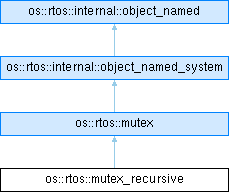
 Inheritance diagram for os::rtos::mutex_recursive:
Public Types | |
| using | count_t = uint16_t |
| Type of variables holding mutex recursion counters. | |
| using | protocol_t = uint8_t |
| Type of variables holding mutex protocols. | |
| using | robustness_t = uint8_t |
| Type of variables holding mutex robustness. | |
| using | type_t = uint8_t |
| Type of variables holding mutex behaviours. | |
Public Member Functions | |
Constructors & Destructor | |
| mutex_recursive (const attributes &attr=initializer_recursive) | |
| Construct a recursive mutex object instance. | |
| mutex_recursive (const char *name, const attributes &attr=initializer_recursive) | |
| Construct a named recursive mutex object instance. | |
| ~mutex_recursive () | |
| Destruct the recursive mutex object instance. | |
Operators | |
| bool | operator== (const mutex_recursive &rhs) const |
| Compare mutexes. | |
Operators | |
| bool | operator== (const mutex &rhs) const |
| Compare mutexes. | |
Public Member Functions | |
| result_t | lock (void) |
| Lock/acquire the mutex. | |
| result_t | try_lock (void) |
| Try to lock/acquire the mutex. | |
| result_t | timed_lock (clock::duration_t timeout) |
| Timed attempt to lock/acquire the mutex. | |
| result_t | unlock (void) |
| Unlock/release the mutex. | |
| thread::priority_t | prio_ceiling (void) const |
| Get the priority ceiling of a mutex. | |
| result_t | prio_ceiling (thread::priority_t prio_ceiling, thread::priority_t *old_prio_ceiling=nullptr) |
| Change the priority ceiling of a mutex. | |
| result_t | consistent (void) |
| Mark mutex as consistent. | |
| thread * | owner (void) |
| Get the thread that owns the mutex. | |
| type_t | type (void) |
| Get the mutex type. | |
| protocol_t | protocol (void) |
| Get the mutex protocol. | |
| robustness_t | robustness (void) |
| Get the mutex robustness. | |
| result_t | reset (void) |
| Reset the mutex. | |
Public Member Functions | |
| const char * | name (void) const |
| Get object name. | |
Static Public Member Functions | |
Operators | |
| static void * | operator new (std::size_t bytes) |
| Allocate space for a new object instance using the RTOS system allocator. | |
| static void * | operator new (std::size_t bytes, void *ptr) |
| Emplace a new object instance. | |
| static void * | operator new[] (std::size_t bytes) |
| Allocate space for an array of new object instances using the RTOS system allocator. | |
| static void * | operator new[] (std::size_t bytes, void *ptr) |
| Emplace an array of new object instances. | |
| static void | operator delete (void *ptr, std::size_t bytes) |
| Deallocate the dynamically allocated object instance. using the RTOS system allocator. | |
| static void | operator delete[] (void *ptr, std::size_t bytes) |
| Deallocate the dynamically allocated array of object. instances using the RTOS system allocator. | |
Static Public Attributes | |
| static const attributes | initializer_normal |
| Default normal mutex initialiser. | |
| static const attributes_recursive | initializer_recursive |
| Default recursive mutex initialiser. | |
| static constexpr count_t | max_count = 0xFFFF |
| Constant with the maximum value for the recursion counter. | |
Definition at line 702 of file os-mutex.h.
|
inline |
| [in] | attr | Reference to attributes. |
This constructor shall initialise a mutex object with attributes referenced by attr. If the attributes specified by attr are modified later, the mutex attributes shall not be affected. Upon successful initialisation, the state of the mutex object shall become initialised.
Only the mutex object itself may be used for performing synchronisation. It is not allowed to make copies of condition variable objects.
In cases where default mutex attributes are appropriate, the variables mutex::initializer_normal or mutex::initializer_recursive can be used to initialise mutex objects. The effect shall be equivalent to creating a mutex object with the default constructor.
If the attr attributes are modified after the mutex creation, the mutex attributes shall not be affected.
pthread_mutex_init() from <pthread.h> (IEEE Std 1003.1, 2013 Edition).Definition at line 854 of file os-mutex.h.
|
inline |
Definition at line 859 of file os-mutex.h.
|
inline |
This destructor shall destroy the mutex object; the object becomes, in effect, uninitialised. An implementation may cause the destructor to set the object to an invalid value.
It shall be safe to destroy an initialised mutex that is unlocked. Attempting to destroy a locked mutex results in undefined behaviour (for example it may trigger an assert).
pthread_mutex_destroy() from <pthread.h> (IEEE Std 1003.1, 2013 Edition).Definition at line 865 of file os-mutex.h.
|
inherited |
| result::ok | The mutex was marked as consistent. |
| EPERM | Cannot be invoked from an Interrupt Service Routines. |
| EINVAL | The mutex object referenced by mutex is not robust or does not protect an inconsistent state. |
If the robust mutex is in an inconsistent state, the consistent() function can be used to mark the state protected by the mutex referenced by mutex as consistent again.
If an owner of a robust mutex terminates while holding the mutex, the mutex becomes inconsistent and the next thread that acquires the mutex lock shall be notified of the state by the return value EOWNERDEAD. In this case, the mutex does not become normally usable again until the state is marked consistent.
If the thread which acquired the mutex lock with the return value EOWNERDEAD terminates before calling either consistent() or unlock(), the next thread that acquires the mutex lock shall be notified about the state of the mutex by the return value EOWNERDEAD.
pthread_mutex_consistent() from <pthread.h> (IEEE Std 1003.1, 2013 Edition).Definition at line 1530 of file os-mutex.cpp.
References os::rtos::interrupts::in_handler_mode(), os::rtos::internal::object_named::name(), os::rtos::result::ok, os_assert_err, os::trace::printf(), and os::rtos::mutex::robustness::robust.
|
inherited |
| result::ok | The mutex was locked. |
| EPERM | Cannot be invoked from an Interrupt Service Routines. |
| ENOTRECOVERABLE | The state protected by the mutex is not recoverable.. |
| EAGAIN | The mutex could not be acquired because the maximum number of recursive locks for mutex has been exceeded. |
| EINVAL | The mutex was created with the protocol attribute having the value mutex::protocol::protect and the calling thread's priority is higher than the mutex's current priority ceiling. |
| EOWNERDEAD | The mutex is a robust mutex and the process containing the previous owning thread terminated while holding the mutex lock. The mutex lock shall be acquired by the calling thread and it is up to the new owner to make the state consistent. |
| EDEADLK | The mutex type is mutex::type::errorcheck and the current thread already owns the mutex. |
If the mutex is free, lock it. If the mutex is already locked by another thread, the calling thread shall block until the mutex becomes available. This operation shall return with the mutex object referenced by mutex in the locked state with the calling thread as its owner. If a thread attempts to relock a mutex that it has already locked, lock() shall behave as described in the Relock column of the following table. If a thread attempts to unlock a mutex that it has not locked or a mutex which is unlocked, unlock() shall behave as described in the Unlock When Not Owner column of the following table.
| Mutex Type | Robustness | Relock | Unlock When Not Owner |
|---|---|---|---|
| normal | non-robust | deadlock | undefined behaviour |
| normal | robust | deadlock | error |
| errorcheck | either | error | error |
| recursive | either | recursive | error |
| default | non-robust | undefined | undefined behaviour |
| default | robust | undefined | error |
Where the table indicates recursive behaviour, the mutex shall maintain the concept of a lock count. When a thread successfully acquires a mutex for the first time, the lock count shall be set to one. Every time a thread relocks this mutex, the lock count shall be incremented by one. Each time the thread unlocks the mutex, the lock count shall be decremented by one. When the lock count reaches zero, the mutex shall become available for other threads to acquire.
pthread_mutex_lock() from <pthread.h> (IEEE Std 1003.1, 2013 Edition).Definition at line 1003 of file os-mutex.cpp.
References os::rtos::interrupts::in_handler_mode(), os::rtos::thread::interrupted(), os::rtos::scheduler::locked(), os::rtos::internal::object_named::name(), os_assert_err, os::trace::printf(), os::rtos::port::scheduler::reschedule(), and os::rtos::this_thread::thread().
Referenced by os::estd::mutex::lock(), os::estd::recursive_mutex::lock(), and os::rtos::mutex::prio_ceiling().
|
inlineinherited |
All objects return a non-null string; anonymous objects return "-".
Definition at line 753 of file os-decls.h.
Referenced by os::memory::lifo::lifo(), os::memory::malloc_memory_resource::malloc_memory_resource(), os::rtos::message_queue_typed< T, Allocator >::message_queue_typed(), os::memory::block_pool::~block_pool(), os::rtos::event_flags::~event_flags(), os::memory::first_fit_top::~first_fit_top(), os::memory::lifo::~lifo(), os::memory::malloc_memory_resource::~malloc_memory_resource(), os::rtos::memory_pool::~memory_pool(), os::rtos::message_queue::~message_queue(), os::rtos::mutex::~mutex(), os::rtos::semaphore::~semaphore(), os::rtos::thread::~thread(), os::rtos::timer::~timer(), os::rtos::memory_pool::alloc(), os::rtos::thread::cancel(), os::rtos::event_flags::clear(), os::rtos::mutex::consistent(), os::rtos::thread::detach(), os::memory::new_delete_memory_resource::do_allocate(), os::memory::block_pool::do_allocate(), os::memory::first_fit_top::do_allocate(), os::memory::lifo::do_allocate(), os::memory::malloc_memory_resource::do_allocate(), os::rtos::thread::flags_raise(), os::rtos::memory_pool::free(), os::rtos::event_flags::get(), os::rtos::thread::interrupt(), os::rtos::thread::join(), os::rtos::thread::kill(), os::rtos::internal::terminated_threads_list::link(), os::rtos::mutex::lock(), os::rtos::memory::memory_resource::out_of_memory_handler(), os::rtos::semaphore::post(), os::rtos::mutex::prio_ceiling(), os::rtos::mutex::prio_ceiling(), os::rtos::thread::priority(), os::rtos::thread::priority_inherited(), os::rtos::event_flags::raise(), os::rtos::message_queue::receive(), os::rtos::memory_pool::reset(), os::rtos::message_queue::reset(), os::rtos::mutex::reset(), os::rtos::semaphore::reset(), os::rtos::thread::resume(), os::rtos::message_queue::send(), os::rtos::clock::sleep_for(), os::rtos::timer::start(), os::rtos::timer::stop(), os::rtos::memory_pool::timed_alloc(), os::rtos::mutex::timed_lock(), os::rtos::message_queue::timed_receive(), os::rtos::message_queue::timed_send(), os::rtos::semaphore::timed_wait(), os::rtos::event_flags::timed_wait(), os::rtos::memory::memory_resource::trace_print_statistics(), os::rtos::memory_pool::try_alloc(), os::rtos::mutex::try_lock(), os::rtos::message_queue::try_receive(), os::rtos::message_queue::try_send(), os::rtos::event_flags::try_wait(), os::rtos::semaphore::try_wait(), os::rtos::internal::ready_threads_list::unlink_head(), os::rtos::mutex::unlock(), os::rtos::event_flags::wait(), os::rtos::semaphore::wait(), and os::rtos::event_flags::waiting().
|
inlinestaticinherited |
| ptr | Pointer to object. |
| bytes | Number of bytes to deallocate. |
The deallocation function (3.7.4.2) called by a delete-expression to render the value of ptr invalid.
ptr shall be a null pointer or its value shall be a value returned by an earlier call to the (possibly replaced) operator new() which has not been invalidated by an intervening call to operator delete(void*).
If ptr is null, does nothing. Otherwise, reclaims the storage allocated by the earlier call to operator new.
The storage is deallocated using the RTOS system allocator.
Definition at line 120 of file os-inlines.h.
References os::rtos::memory::allocator_stateless_default_resource< T >::deallocate(), and os::rtos::interrupts::in_handler_mode().
|
inlinestaticinherited |
| ptr | Pointer to array of objects. |
| bytes | Number of bytes to deallocate. |
The deallocation function (3.7.4.2) called by the array form of a delete-expression to render the value of ptr invalid.
If ptr is null, does nothing. Otherwise, reclaims the storage allocated by the earlier call to operator new.
The storage is deallocated using the RTOS system allocator.
Definition at line 141 of file os-inlines.h.
|
inlinestaticinherited |
| bytes | Number of bytes to allocate. |
The allocation function (3.7.4.1) called by a new-expression (5.3.4) to allocate a storage of size bytes suitably aligned to represent any object of that size. Return a non-null pointer to suitably aligned storage (3.7.4).
The storage is allocated using the RTOS system allocator.
Definition at line 43 of file os-inlines.h.
References os::rtos::memory::allocator_stateless_default_resource< T >::allocate(), and os::rtos::interrupts::in_handler_mode().
|
inlinestaticinherited |
| bytes | Number of bytes to emplace. |
| ptr | Pointer to location to emplace the object. |
The allocation function (3.7.4.1) called by a placement new-expression to allocate a storage of size bytes suitably aligned to represent any object of that size. Return a non-null pointer to suitably aligned storage (3.7.4).
The storage is allocated using the RTOS system allocator.
Definition at line 80 of file os-inlines.h.
|
inlinestaticinherited |
| bytes | Number of bytes to allocate. |
The allocation function (3.7.4.1) called by the array form of a new-expression (5.3.4) to allocate a storage of size bytes suitably aligned to represent any array object of that size or smaller.
The storage is allocated using the RTOS system allocator.
Definition at line 61 of file os-inlines.h.
|
inlinestaticinherited |
| bytes | Number of bytes to emplace. |
| ptr | Pointer to location to emplace the object. |
The allocation function (3.7.4.1) called by the array form of a placement new-expression to allocate a storage of size bytes suitably aligned to represent any array object of that size or smaller.
The storage is allocated using the RTOS system allocator.
Definition at line 97 of file os-inlines.h.
|
inlineinherited |
| true | The given mutex is the same as this mutex. |
| false | The mutexes are different. |
Identical mutexes should have the same memory address.
Definition at line 811 of file os-mutex.h.
|
inline |
| true | The given mutex is the same as this mutex. |
| false | The mutexes are different. |
Identical mutexes should have the same memory address.
Definition at line 874 of file os-mutex.h.
|
inlineinherited |
nullptr if not owned.Definition at line 820 of file os-mutex.h.
|
inherited |
| [in] | prio_ceiling | new priority. |
| [out] | old_prio_ceiling | pointer to location where to store the previous priority; may be nullptr. |
| result::ok | The priority was changed. |
| EPERM | Cannot be invoked from an Interrupt Service Routines. |
| ENOTRECOVERABLE | The state protected by the mutex is not recoverable.. |
| EAGAIN | The mutex could not be acquired because the maximum number of recursive locks for mutex has been exceeded. |
| EINVAL | The mutex was created with the protocol attribute having the value mutex::protocol::protect and the calling thread's priority is higher than the mutex's current priority ceiling. |
| EOWNERDEAD | The mutex is a robust mutex and the process containing the previous owning thread terminated while holding the mutex lock. The mutex lock shall be acquired by the calling thread and it is up to the new owner to make the state consistent. |
| EDEADLK | The mutex type is mutex::type::errorcheck and the current thread already owns the mutex. |
Attempt to lock the mutex as if by a call to lock(), except that the process of locking the mutex need not adhere to the priority protect protocol. On acquiring the mutex it shall change the mutex's priority ceiling and then release the mutex as if by a call to unlock(). When the change is successful, the previous value of the priority ceiling shall be returned in old_prio_ceiling.
If prio_ceiling() function fails, the mutex priority ceiling shall not be changed.
pthread_mutex_setprioceiling() from <pthread.h> (IEEE Std 1003.1, 2013 Edition).Definition at line 1461 of file os-mutex.cpp.
References os::rtos::interrupts::in_handler_mode(), os::rtos::mutex::lock(), os::rtos::internal::object_named::name(), os::rtos::result::ok, os_assert_err, os::trace::printf(), os::rtos::mutex::prio_ceiling(), and os::rtos::mutex::unlock().
|
inherited |
Return the current priority ceiling of the mutex.
pthread_mutex_getprioceiling() from <pthread.h> (IEEE Std 1003.1, 2013 Edition).Definition at line 1417 of file os-mutex.cpp.
References os::rtos::interrupts::in_handler_mode(), os::rtos::internal::object_named::name(), and os::trace::printf().
Referenced by os::rtos::mutex::prio_ceiling().
|
inlineinherited |
Definition at line 838 of file os-mutex.h.
|
inherited |
| result::ok | The mutex was reset. |
Return the mutex to the state right after creation. If there were threads waiting for this mutex, wakeup all, then clear the waiting list.
Definition at line 1567 of file os-mutex.cpp.
References os::rtos::interrupts::in_handler_mode(), os::rtos::internal::object_named::name(), os::rtos::result::ok, os_assert_err, and os::trace::printf().
|
inlineinherited |
Definition at line 847 of file os-mutex.h.
|
inherited |
| [in] | timeout | Timeout to wait, in clock units (ticks or seconds). |
| result::ok | The mutex was locked. |
| EPERM | Cannot be invoked from an Interrupt Service Routines. |
| ETIMEDOUT | The mutex could not be locked before the specified timeout expired. |
| ENOTRECOVERABLE | The state protected by the mutex is not recoverable. |
| EAGAIN | The mutex could not be acquired because the maximum number of recursive locks for mutex has been exceeded. |
| EDEADLK | The mutex type is mutex::type::errorcheck and the current thread already owns the mutex. |
| EINVAL | The process or thread would have blocked, and the timeout parameter is invalid. |
| EOWNERDEAD | The mutex is a robust mutex and the process containing the previous owning thread terminated while holding the mutex lock. The mutex lock shall be acquired by the calling thread and it is up to the new owner to make the state consistent. |
If the mutex is already locked, the calling thread shall block until the mutex becomes available as in the lock() function. If the mutex cannot be locked without waiting for another thread to unlock the mutex, this wait shall be terminated when the specified timeout expires.
The timeout shall expire after the number of time units (that is when the value of that clock equals or exceeds (now()+duration). The resolution of the timeout shall be the resolution of the clock on which it is based.
Under no circumstance shall the function fail with a timeout if the mutex can be locked immediately. The validity of the timeout need not be checked if the mutex can be locked immediately.
The clock used for timeouts can be specified via the clock attribute. By default, the clock derived from the scheduler timer is used, and the durations are expressed in ticks.
As a consequence of the priority inheritance rules (for mutexes initialized with mutex::protocol::inherit), if a timed mutex wait is terminated because its timeout expires, the priority of the owner of the mutex shall be adjusted as necessary to reflect the fact that this thread is no longer among the threads waiting for the mutex.
pthread_mutex_timedlock() from <pthread.h> (IEEE Std 1003.1, 2013 Edition). Definition at line 1205 of file os-mutex.cpp.
References os::rtos::interrupts::in_handler_mode(), os::rtos::thread::interrupted(), os::rtos::scheduler::locked(), os::rtos::internal::object_named::name(), os::rtos::thread::priority::none, os::rtos::result::ok, os_assert_err, os::trace::printf(), os::rtos::port::scheduler::reschedule(), and os::rtos::this_thread::thread().
Referenced by os::estd::timed_mutex::try_lock_for(), and os::estd::recursive_timed_mutex::try_lock_for().
|
inherited |
| result::ok | The mutex was locked. |
| EPERM | Cannot be invoked from an Interrupt Service Routines. |
| ENOTRECOVERABLE | The state protected by the mutex is not recoverable.. |
| EAGAIN | The mutex could not be acquired because the maximum number of recursive locks for mutex has been exceeded. |
| EINVAL | The mutex was created with the protocol attribute having the value mutex::protocol::protect and the calling thread's priority is higher than the mutex's current priority ceiling. |
| EOWNERDEAD | The mutex is a robust mutex and the process containing the previous owning thread terminated while holding the mutex lock. The mutex lock shall be acquired by the calling thread and it is up to the new owner to make the state consistent. |
| EDEADLK | The mutex type is mutex::type::errorcheck and the current thread already owns the mutex. |
| EWOULDBLOCK | The mutex could not be acquired because it was already locked. |
Try to lock the mutex as lock(), except that if the mutex is currently locked (by any thread, including the current thread), the call shall return immediately. If the mutex type is mutex::type::recursive and the mutex is currently owned by the calling thread, the mutex lock count shall be incremented by one and the try_lock() function shall immediately return success.
If the mutex is robust and the owning thread terminated while holding the mutex lock, a call to try_lock() may return the error value EOWNERDEAD. In these cases, the mutex is locked by the thread but the state it protects is marked as inconsistent. The application should ensure that the state is made consistent for reuse and when that is complete call consistent(). If the application is unable to recover the state, it should unlock the mutex without a prior call to consistent(), after which the mutex is marked permanently unusable.
pthread_mutex_trylock() from <pthread.h> (IEEE Std 1003.1, 2013 Edition). Definition at line 1126 of file os-mutex.cpp.
References os::rtos::interrupts::in_handler_mode(), os::rtos::internal::object_named::name(), os_assert_err, os::trace::printf(), and os::rtos::this_thread::thread().
Referenced by os::estd::mutex::try_lock(), and os::estd::recursive_mutex::try_lock().
|
inlineinherited |
Definition at line 829 of file os-mutex.h.
|
inherited |
| result::ok | The mutex was unlocked. |
| EPERM | Cannot be invoked from an Interrupt Service Routine; the mutex type is mutex::type::errorcheck or mutex::type::recursive, or the mutex is a robust mutex, and the current thread does not own the mutex. |
| ENOTRECOVERABLE | The recursive mutex whose oner died was not marked consistent() before unlock(). |
The manner in which a mutex is released is dependent upon the mutex's type attribute. If there are threads blocked on the mutex object referenced by mutex when unlock() is called, resulting in the mutex becoming available, the scheduling policy shall determine which thread shall acquire the mutex.
In the case of mutex::type::recursive mutexes, the mutex shall become available when the count reaches zero and the calling thread no longer has any locks on this mutex.
pthread_mutex_unlock() from <pthread.h> (IEEE Std 1003.1, 2013 Edition).Definition at line 1379 of file os-mutex.cpp.
References os::rtos::interrupts::in_handler_mode(), os::rtos::internal::object_named::name(), os_assert_err, os::trace::printf(), and os::rtos::this_thread::thread().
Referenced by os::rtos::mutex::prio_ceiling(), os::estd::mutex::unlock(), and os::estd::recursive_mutex::unlock().
 1.9.7
1.9.7