 |
µOS++ IIIe Reference 7.0.0
The third edition of µOS++, a POSIX inspired open source framework, written in C++
|
|
µOS++ IIIe Reference 7.0.0
The third edition of µOS++, a POSIX inspired open source framework, written in C++
|
Template of a synchronised memory pool with allocator. More...
#include <cmsis-plus/rtos/os.h>
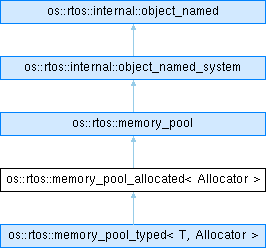
 Inheritance diagram for os::rtos::memory_pool_allocated< Allocator >:
Public Types | |
| using | allocator_type = Allocator |
| Standard allocator type definition. | |
| using | size_t = uint16_t |
| Type of memory pool size storage. | |
Public Member Functions | |
| template<typename T > | |
| constexpr std::size_t | compute_allocated_size_bytes (std::size_t blocks, std::size_t block_size_bytes) |
| Calculator for pool storage requirements. | |
Constructors & Destructor | |
| memory_pool_allocated (std::size_t blocks, std::size_t block_size_bytes, const attributes &attr=initializer, const allocator_type &allocator=allocator_type()) | |
| Construct a memory pool object instance. | |
| memory_pool_allocated (const char *name, std::size_t blocks, std::size_t block_size_bytes, const attributes &attr=initializer, const allocator_type &allocator=allocator_type()) | |
| Construct a named memory pool object instance. | |
| virtual | ~memory_pool_allocated () override |
| Destruct the memory pool object instance. | |
Operators | |
| bool | operator== (const memory_pool &rhs) const |
| Compare memory pools. | |
Public Member Functions | |
| void * | alloc (void) |
| Allocate a memory block. | |
| void * | try_alloc (void) |
| Try to allocate a memory block. | |
| void * | timed_alloc (clock::duration_t timeout) |
| Allocate a memory block with timeout. | |
| result_t | free (void *block) |
| Free the memory block. | |
| std::size_t | capacity (void) const |
| Get memory pool capacity. | |
| std::size_t | count (void) const |
| Get blocks count. | |
| std::size_t | block_size (void) const |
| Get block size. | |
| bool | empty (void) const |
| Check if the memory pool is empty. | |
| bool | full (void) const |
| Check if the memory pool is full. | |
| result_t | reset (void) |
| Reset the memory pool. | |
| void * | pool (void) |
| Get the pool storage address. | |
Public Member Functions | |
| const char * | name (void) const |
| Get object name. | |
Static Public Member Functions | |
Operators | |
| static void * | operator new (std::size_t bytes) |
| Allocate space for a new object instance using the RTOS system allocator. | |
| static void * | operator new (std::size_t bytes, void *ptr) |
| Emplace a new object instance. | |
| static void * | operator new[] (std::size_t bytes) |
| Allocate space for an array of new object instances using the RTOS system allocator. | |
| static void * | operator new[] (std::size_t bytes, void *ptr) |
| Emplace an array of new object instances. | |
| static void | operator delete (void *ptr, std::size_t bytes) |
| Deallocate the dynamically allocated object instance. using the RTOS system allocator. | |
| static void | operator delete[] (void *ptr, std::size_t bytes) |
| Deallocate the dynamically allocated array of object. instances using the RTOS system allocator. | |
Static Public Attributes | |
| static const attributes | initializer |
| Default memory pool initialiser. | |
| static constexpr memory_pool::size_t | max_size = static_cast<memory_pool::size_t> (0 - 1) |
| Maximum pool size. | |
Definition at line 544 of file os-mempool.h.
| using os::rtos::memory_pool_allocated< Allocator >::allocator_type = Allocator |
Definition at line 550 of file os-mempool.h.
|
inline |
| [in] | blocks | The maximum number of items in the pool. |
| [in] | block_size_bytes | The size of an item, in bytes. |
| [in] | attr | Reference to attributes. |
| [in] | allocator | Reference to allocator. Default a local temporary instance. |
This constructor shall initialise a memory pool object with attributes referenced by attr. If the attributes specified by attr are modified later, the memory pool attributes shall not be affected. Upon successful initialisation, the state of the memory pool variable shall become initialised.
Only the memory pool itself may be used for allocations. It is not allowed to make copies of condition variable objects.
In cases where default memory pool attributes are appropriate, the variable memory_pool::initializer can be used to initialise condition variables. The effect shall be equivalent to creating a memory pool object with the simple constructor.
If the attributes define a storage area (via mp_pool_address and mp_pool_size_bytes), that storage is used, otherwise the storage is dynamically allocated using the RTOS specific allocator (rtos::memory::allocator).
Definition at line 992 of file os-mempool.h.
| os::rtos::memory_pool_allocated< Allocator >::memory_pool_allocated | ( | const char * | name, |
| std::size_t | blocks, | ||
| std::size_t | block_size_bytes, | ||
| const attributes & | attr = initializer, |
||
| const allocator_type & | allocator = allocator_type () |
||
| ) |
| [in] | name | Pointer to name. |
| [in] | blocks | The maximum number of items in the pool. |
| [in] | block_size_bytes | The size of an item, in bytes. |
| [in] | attr | Reference to attributes. |
| [in] | allocator | Reference to allocator. Default a local temporary instance. |
This constructor shall initialise a named memory pool object with attributes referenced by attr. If the attributes specified by attr are modified later, the memory pool attributes shall not be affected. Upon successful initialisation, the state of the memory pool variable shall become initialised.
Only the memory pool itself may be used for allocations. It is not allowed to make copies of condition variable objects.
In cases where default memory pool attributes are appropriate, the variable memory_pool::initializer can be used to initialise condition variables. The effect shall be equivalent to creating a memory pool object with the simple constructor.
If the attributes define a storage area (via mp_pool_address and mp_pool_size_bytes), that storage is used, otherwise the storage is dynamically allocated using the RTOS specific allocator (rtos::memory::allocator).
Definition at line 1026 of file os-mempool.h.
References os::rtos::memory_pool::compute_allocated_size_bytes(), os::rtos::memory_pool::attributes::mp_pool_address, and os::trace::printf().
|
overridevirtual |
This destructor shall destroy a memory pool object; the object becomes, in effect, uninitialised. An implementation may cause the destructor to set the object to an invalid value.
It shall be safe to destroy an initialised memory pool object upon which no threads are currently blocked. Attempting to destroy a memory pool object upon which other threads are currently blocked results in undefined behaviour.
If the storage for the memory pool was dynamically allocated, it is deallocated using the same allocator.
Definition at line 1081 of file os-mempool.h.
References os::trace::printf().
|
inherited |
nullptr if interrupted.The alloc() function shall allocate a fixed size memory block from the memory pool.
If the memory pool is empty, alloc() shall block until a block is freed or until alloc() is cancelled/interrupted. If more than one thread is waiting to allocate a block, when a block is freed and the Priority Scheduling option is supported, then the thread of highest priority that has been waiting the longest shall be selected to allocate the block. Otherwise, it is unspecified which waiting thread allocates the block.
This function uses a critical section to protect against simultaneous access from other threads or interrupts.
Definition at line 510 of file os-mempool.cpp.
References os::rtos::interrupts::in_handler_mode(), os::rtos::scheduler::locked(), os::rtos::internal::object_named::name(), os_assert_throw, os::trace::printf(), os::rtos::port::scheduler::reschedule(), and os::rtos::this_thread::thread().
Referenced by os::rtos::memory_pool_typed< T, Allocator >::alloc(), and os::rtos::memory_pool_inclusive< T, N >::alloc().
|
inlineinherited |
Definition at line 923 of file os-mempool.h.
|
inlineinherited |
Definition at line 914 of file os-mempool.h.
Referenced by os::rtos::memory_pool::full().
|
inlineconstexprinherited |
| blocks | Number of blocks. |
| block_size_bytes | Size of block. |
Definition at line 188 of file os-mempool.h.
Referenced by os::rtos::memory_pool::memory_pool(), and os::rtos::memory_pool_allocated< Allocator >::memory_pool_allocated().
|
inlineinherited |
Definition at line 932 of file os-mempool.h.
Referenced by os::rtos::memory_pool::empty(), and os::rtos::memory_pool::full().
|
inlineinherited |
| true | The memory pool has no allocated blocks. |
| false | The memory pool has allocated blocks. |
Definition at line 941 of file os-mempool.h.
References os::rtos::memory_pool::count().
|
inherited |
| [in] | block | Pointer to memory block to free. |
| result::ok | The memory block was released. |
| EINVAL | The block does not belong to the memory pool. |
Return a memory block previously allocated by alloc() back to the memory pool.
It uses a critical section to protect simultaneous access from other threads or interrupts.
Definition at line 781 of file os-mempool.cpp.
References os::rtos::internal::object_named::name(), os::rtos::result::ok, and os::trace::printf().
Referenced by os::rtos::memory_pool_typed< T, Allocator >::free(), and os::rtos::memory_pool_inclusive< T, N >::free().
|
inlineinherited |
| true | All memory blocks are allocated. |
| false | There are still memory blocks that can be allocated. |
Definition at line 950 of file os-mempool.h.
References os::rtos::memory_pool::capacity(), and os::rtos::memory_pool::count().
|
inlineinherited |
All objects return a non-null string; anonymous objects return "-".
Definition at line 753 of file os-decls.h.
Referenced by os::memory::lifo::lifo(), os::memory::malloc_memory_resource::malloc_memory_resource(), os::rtos::message_queue_typed< T, Allocator >::message_queue_typed(), os::memory::block_pool::~block_pool(), os::rtos::event_flags::~event_flags(), os::memory::first_fit_top::~first_fit_top(), os::memory::lifo::~lifo(), os::memory::malloc_memory_resource::~malloc_memory_resource(), os::rtos::memory_pool::~memory_pool(), os::rtos::message_queue::~message_queue(), os::rtos::mutex::~mutex(), os::rtos::semaphore::~semaphore(), os::rtos::thread::~thread(), os::rtos::timer::~timer(), os::rtos::memory_pool::alloc(), os::rtos::thread::cancel(), os::rtos::event_flags::clear(), os::rtos::mutex::consistent(), os::rtos::thread::detach(), os::memory::new_delete_memory_resource::do_allocate(), os::memory::block_pool::do_allocate(), os::memory::first_fit_top::do_allocate(), os::memory::lifo::do_allocate(), os::memory::malloc_memory_resource::do_allocate(), os::rtos::thread::flags_raise(), os::rtos::memory_pool::free(), os::rtos::event_flags::get(), os::rtos::thread::interrupt(), os::rtos::thread::join(), os::rtos::thread::kill(), os::rtos::internal::terminated_threads_list::link(), os::rtos::mutex::lock(), os::rtos::memory::memory_resource::out_of_memory_handler(), os::rtos::semaphore::post(), os::rtos::mutex::prio_ceiling(), os::rtos::mutex::prio_ceiling(), os::rtos::thread::priority(), os::rtos::thread::priority_inherited(), os::rtos::event_flags::raise(), os::rtos::message_queue::receive(), os::rtos::memory_pool::reset(), os::rtos::message_queue::reset(), os::rtos::mutex::reset(), os::rtos::semaphore::reset(), os::rtos::thread::resume(), os::rtos::message_queue::send(), os::rtos::clock::sleep_for(), os::rtos::timer::start(), os::rtos::timer::stop(), os::rtos::memory_pool::timed_alloc(), os::rtos::mutex::timed_lock(), os::rtos::message_queue::timed_receive(), os::rtos::message_queue::timed_send(), os::rtos::semaphore::timed_wait(), os::rtos::event_flags::timed_wait(), os::rtos::memory::memory_resource::trace_print_statistics(), os::rtos::memory_pool::try_alloc(), os::rtos::mutex::try_lock(), os::rtos::message_queue::try_receive(), os::rtos::message_queue::try_send(), os::rtos::event_flags::try_wait(), os::rtos::semaphore::try_wait(), os::rtos::internal::ready_threads_list::unlink_head(), os::rtos::mutex::unlock(), os::rtos::event_flags::wait(), os::rtos::semaphore::wait(), and os::rtos::event_flags::waiting().
|
inlinestaticinherited |
| ptr | Pointer to object. |
| bytes | Number of bytes to deallocate. |
The deallocation function (3.7.4.2) called by a delete-expression to render the value of ptr invalid.
ptr shall be a null pointer or its value shall be a value returned by an earlier call to the (possibly replaced) operator new() which has not been invalidated by an intervening call to operator delete(void*).
If ptr is null, does nothing. Otherwise, reclaims the storage allocated by the earlier call to operator new.
The storage is deallocated using the RTOS system allocator.
Definition at line 120 of file os-inlines.h.
References os::rtos::memory::allocator_stateless_default_resource< T >::deallocate(), and os::rtos::interrupts::in_handler_mode().
|
inlinestaticinherited |
| ptr | Pointer to array of objects. |
| bytes | Number of bytes to deallocate. |
The deallocation function (3.7.4.2) called by the array form of a delete-expression to render the value of ptr invalid.
If ptr is null, does nothing. Otherwise, reclaims the storage allocated by the earlier call to operator new.
The storage is deallocated using the RTOS system allocator.
Definition at line 141 of file os-inlines.h.
|
inlinestaticinherited |
| bytes | Number of bytes to allocate. |
The allocation function (3.7.4.1) called by a new-expression (5.3.4) to allocate a storage of size bytes suitably aligned to represent any object of that size. Return a non-null pointer to suitably aligned storage (3.7.4).
The storage is allocated using the RTOS system allocator.
Definition at line 43 of file os-inlines.h.
References os::rtos::memory::allocator_stateless_default_resource< T >::allocate(), and os::rtos::interrupts::in_handler_mode().
|
inlinestaticinherited |
| bytes | Number of bytes to emplace. |
| ptr | Pointer to location to emplace the object. |
The allocation function (3.7.4.1) called by a placement new-expression to allocate a storage of size bytes suitably aligned to represent any object of that size. Return a non-null pointer to suitably aligned storage (3.7.4).
The storage is allocated using the RTOS system allocator.
Definition at line 80 of file os-inlines.h.
|
inlinestaticinherited |
| bytes | Number of bytes to allocate. |
The allocation function (3.7.4.1) called by the array form of a new-expression (5.3.4) to allocate a storage of size bytes suitably aligned to represent any array object of that size or smaller.
The storage is allocated using the RTOS system allocator.
Definition at line 61 of file os-inlines.h.
|
inlinestaticinherited |
| bytes | Number of bytes to emplace. |
| ptr | Pointer to location to emplace the object. |
The allocation function (3.7.4.1) called by the array form of a placement new-expression to allocate a storage of size bytes suitably aligned to represent any array object of that size or smaller.
The storage is allocated using the RTOS system allocator.
Definition at line 97 of file os-inlines.h.
|
inlineinherited |
| true | The given memory pool is the same as this memory pool. |
| false | The memory pools are different. |
Identical memory pools should have the same memory address.
Definition at line 905 of file os-mempool.h.
|
inlineinherited |
Definition at line 959 of file os-mempool.h.
|
inherited |
| result::ok | The memory pool was reset. |
| EPERM | Cannot be invoked from an Interrupt Service Routines. |
Reset the memory pool to the initial state, with all blocks free.
Definition at line 846 of file os-mempool.cpp.
References os::rtos::interrupts::in_handler_mode(), os::rtos::internal::object_named::name(), os::rtos::result::ok, os_assert_err, and os::trace::printf().
|
inherited |
| [in] | timeout | Timeout to wait, in clock units (ticks or seconds). |
nullptr if timeout.The timed_alloc() function shall allocate a fixed size memory block from the memory pool.
If the memory pool is empty, timed_alloc() shall block until a block is freed or until timed_alloc() is cancelled/interrupted. If more than one thread is waiting to allocate a block, when a block is freed and the Priority Scheduling option is supported, then the thread of highest priority that has been waiting the longest shall be selected to allocate the block. Otherwise, it is unspecified which waiting thread allocates the block.
The timed_alloc() function shall allocate any of the available blocks, regardless of their age and the order they were freed. However, if no blocks are available, the wait for such a block shall be terminated when the specified timeout expires.
The timeout shall expire after the number of time units (that is when the value of that clock equals or exceeds (now()+duration). The resolution of the timeout shall be the resolution of the clock on which it is based.
Under no circumstance shall the operation fail with a timeout if a block can be allocated from the memory pool immediately. The validity of the timeout need not be checked if the block can be allocated immediately.
The clock used for timeouts can be specified via the clock attribute. By default, the clock derived from the scheduler timer is used, and the durations are expressed in ticks.
This function uses a critical section to protect against simultaneous access from other threads or interrupts.
Definition at line 669 of file os-mempool.cpp.
References os::rtos::interrupts::in_handler_mode(), os::rtos::scheduler::locked(), os::rtos::internal::object_named::name(), os_assert_throw, os::trace::printf(), os::rtos::port::scheduler::reschedule(), and os::rtos::this_thread::thread().
Referenced by os::rtos::memory_pool_typed< T, Allocator >::timed_alloc(), and os::rtos::memory_pool_inclusive< T, N >::timed_alloc().
|
inherited |
nullptr if no memory available.Try to allocate a fixed size memory block from the memory pool, if available, return it, otherwise return nullptr.
The timed_alloc() function shall try to allocate a fixed size memory block from the memory pool.
If the memory pool is empty, timed_alloc() shall immediately return 'nullptr'.
This function uses a critical section to protect against simultaneous access from other threads or interrupts.
Definition at line 604 of file os-mempool.cpp.
References os::rtos::internal::object_named::name(), and os::trace::printf().
Referenced by os::rtos::memory_pool_typed< T, Allocator >::try_alloc(), and os::rtos::memory_pool_inclusive< T, N >::try_alloc().
 1.9.7
1.9.7